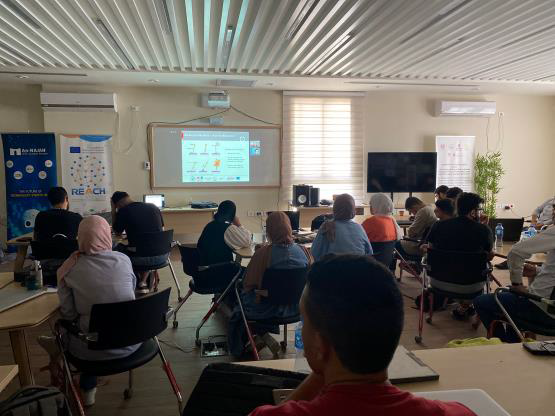
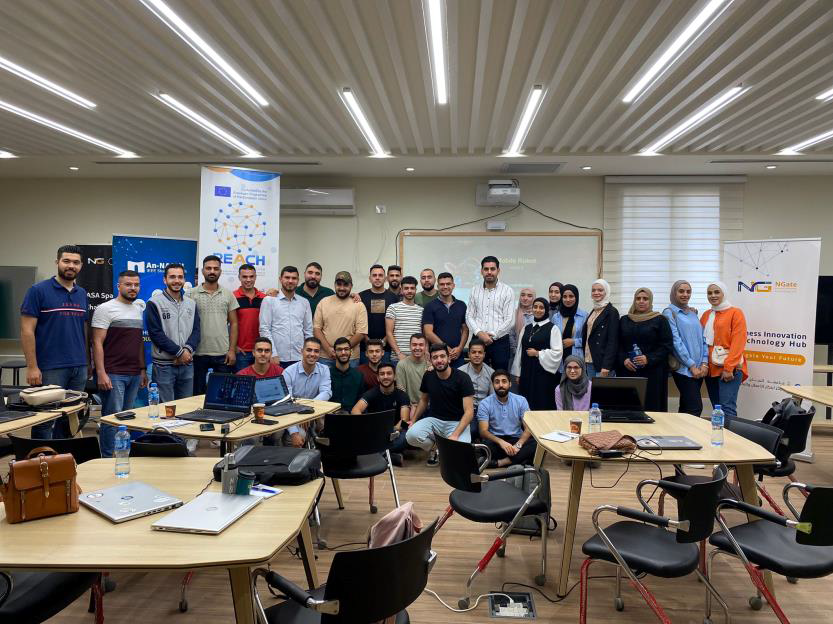
An-Najah National University conducted a 30-hours training module in the field of Robotics Technology. The training was covered in a workshop fashion and has national and international trainers from Palestine, Luxembourg and Italy.
It is worth mentioning that 35 graduates and students participated in the training from different disciplines including mechatronics, industrial, computer engineering and IT from different universities (ANNU, Birzeit, Al-Quds Open University). Also, the national trainers got a TOT training in Ljubljana- Slovenia last May.
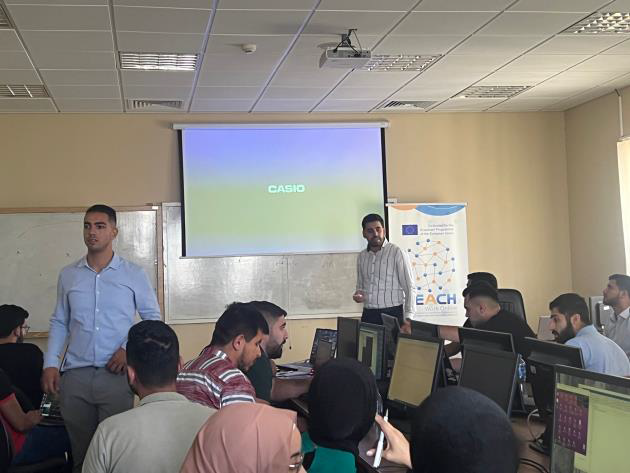
The training covers the following topics:
- An introduction to Industrial Robotics Technology and its applications. Different robots’ architecture has been explained and discussed to the students such as articulated robots, cartesian coordinate robots, cylindrical coordinate robots, spherical coordinate robots, SCARA robots, Delta robots, Serial manipulators, and Parallel Architecture. Finally, the trainers introduce the students to different robot applications of robots including welding, painting, assembly, disassembly, pick and place, packaging and labelling, palletizing, product inspection and testing, etc.
- A practical training was conducted to train the student on programing an ABB robot using RobotStudio software. This training gives the student the ability to build, test and refine a robot installation in a virtual environment by carrying out several programming and simulation examples.
- An introduction to Mobile Robotics Technology and its applications. The students have the chance to get to know what mobile robot is and their capability to move around their environment autonomously. Different applications for the mobile robot have been discussed, such as hospital autonomous mobile robots, Warehouse mobile robotic systems, military and security mobile robots.
- An introduction to Humanoid Robot (H.R.) system. The concept of Humanoid robots has been discussed and how the researchers study the human body structure and behaviour (biomechanics) to build H.R. using several actuators and sensors. Different applications of Humanoid robots have been shown such as the use of H.R. in Medical, research, Entertainment, and Demonstrative, etc.
- A practical introduction to Robotic Operating System (ROS). The students have learned the architecture of ROS and how can be implemented in a Mobile Robot system. The integration between ROS and MATLAB has been also introduced with several practical examples to allow the student to program virtual mobile robots and test it on Gazebo simulation software.
- The use of Robotic systems in 3D printing Technology. The students have the chance to learn about the new technology of Robot 3D printing, also called robotic 3D printing and robotic additive manufacturing, which combines a 3D printer head to extrude the material with a robotic system to create a much more flexible 3D printer than the conventional models.